
This page was generated from
examples/ConsBequestModel/example_WarmGlowBequest.ipynb.
Interactive online version: .
Download notebook.
.
Download notebook.
Interactive online version:
.
Download notebook.
Warm-Glow Bequest Motive#
This notebook only provides examples, without explaining the model. It will be revised and improved in the near future.
[1]:
from copy import copy
from time import time

import matplotlib.pyplot as plt
import pandas as pd

from HARK.Calibration.Income.IncomeTools import (
    CGM_income,
    parse_income_spec,
    parse_time_params,
)
from HARK.Calibration.life_tables.us_ssa.SSATools import parse_ssa_life_table
from HARK.Calibration.SCF.WealthIncomeDist.SCFDistTools import (
    income_wealth_dists_from_scf,
)
from HARK.ConsumptionSaving.ConsBequestModel import (
    BequestWarmGlowConsumerType,
    init_warm_glow,
)
from HARK.utilities import plot_funcs
[2]:
birth_age = 25
death_age = 120
adjust_infl_to = 1992
income_calib = CGM_income
education = "College"

# Income specification
income_params = parse_income_spec(
    age_min=birth_age,
    age_max=death_age,
    adjust_infl_to=adjust_infl_to,
    **income_calib[education],
    SabelhausSong=True,
)

# Initial distribution of wealth and permanent income
dist_params = income_wealth_dists_from_scf(
    base_year=adjust_infl_to,
    age=birth_age,
    education=education,
    wave=1995,
)

# We need survival probabilities only up to death_age-1, because survival
# probability at death_age is 1.
liv_prb = parse_ssa_life_table(
    female=True,
    cross_sec=True,
    year=2004,
    age_min=birth_age,
    age_max=death_age,
)

# Parameters related to the number of periods implied by the calibration
time_params = parse_time_params(age_birth=birth_age, age_death=death_age)

# Update all the new parameters
params = copy(init_warm_glow)
params.update(time_params)
params.update(dist_params)
params.update(income_params)
params.update({"LivPrb": liv_prb})
params["Rfree"] = len(liv_prb) * [params["Rfree"][0]]
[3]:
# Make and solve an idiosyncratic shocks consumer with a finite lifecycle
Agent = BequestWarmGlowConsumerType(**params)
# Make this consumer live a sequence of periods exactly once
Agent.cycles = 1
[4]:
start_time = time()
Agent.solve()
end_time = time()
print(f"Solving a lifecycle consumer took {end_time - start_time} seconds.")
Agent.unpack("cFunc")
Solving a lifecycle consumer took 0.06401491165161133 seconds.
[5]:
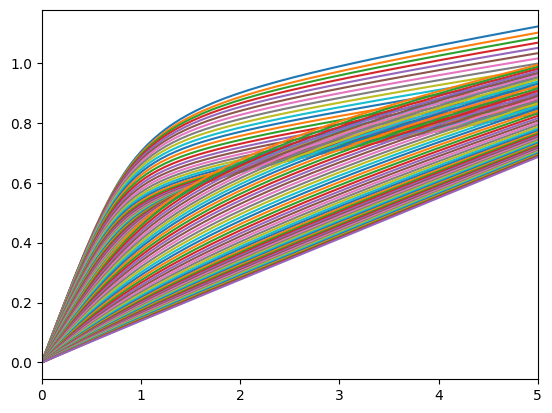
# Plot the consumption functions
print("Consumption functions")
plot_funcs(Agent.cFunc, 0, 5)
Consumption functions
[6]:
# Number of LifecycleExamples and periods in the simulation.
Agent.AgentCount = 500
Agent.T_sim = 200

# Set up the variables we want to keep track of.
Agent.track_vars = ["aNrm", "cNrm", "pLvl", "t_age", "mNrm"]

# Run the simulations
Agent.initialize_sim()
Agent.simulate()
[7]:
raw_data = {
    "Age": Agent.history["t_age"].flatten() + birth_age - 1,
    "pIncome": Agent.history["pLvl"].flatten(),
    "nrmM": Agent.history["mNrm"].flatten(),
    "nrmC": Agent.history["cNrm"].flatten(),
}

Data = pd.DataFrame(raw_data)
Data["Cons"] = Data.nrmC * Data.pIncome
Data["M"] = Data.nrmM * Data.pIncome
[8]:
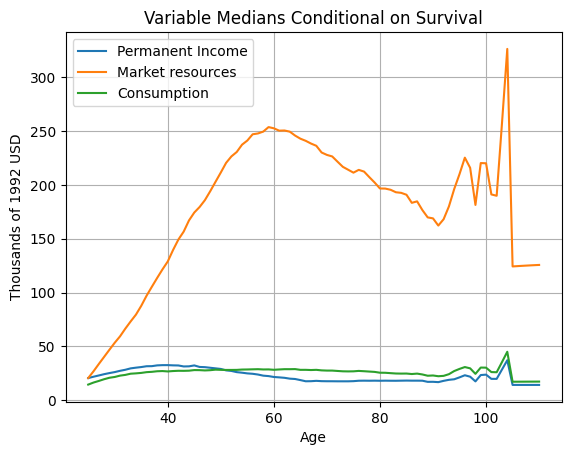
# Find the mean of each variable at every age
AgeMeans = Data.groupby(["Age"]).median().reset_index()

plt.figure()
plt.plot(AgeMeans.Age, AgeMeans.pIncome, label="Permanent Income")
plt.plot(AgeMeans.Age, AgeMeans.M, label="Market resources")
plt.plot(AgeMeans.Age, AgeMeans.Cons, label="Consumption")
plt.legend()
plt.xlabel("Age")
plt.ylabel(f"Thousands of {adjust_infl_to} USD")
plt.title("Variable Medians Conditional on Survival")
plt.grid()
[ ]: